The Cobbler, the Radio Doctor, and America's Lost Art of Making Things Last
Walk through any American town in 1960, and you'd find them on nearly every main street: small shops with hand-painted signs advertising shoe repair, radio service, or watch cleaning. These weren't quaint throwbacks to an earlier era—they were thriving businesses that formed the backbone of a culture that viewed broken as fixable, not disposable.
Today, those shops have vanished so completely that many Americans under 40 have never seen a cobbler at work. In their place, we have a throwaway economy where a broken heel means new shoes, a cracked screen means a new phone, and a worn-out appliance means a trip to the big-box store.
The Neighborhood Fixers
Every community had its cast of repair specialists, each with their own domain of expertise. The cobbler knew leather like a vintner knows wine, able to assess a worn sole or stretched upper with a glance. The radio repairman could diagnose a failing tube by the quality of the static. The watch repair shop owner worked with jeweler's precision, replacing springs and gears smaller than grains of rice.
"My father could look at a pair of shoes and tell you exactly what was wrong and how long they'd last once he fixed them," recalls Anthony DiMarco, whose family ran a shoe repair shop in Boston's North End for three generations. "People would bring in shoes that looked completely shot, and he'd have them looking like new again. The customer would wear them for another five years easy."
 Photo: Boston's North End, via c8.alamy.com
These weren't emergency services—they were planned parts of household budgeting. Families would schedule regular maintenance for their shoes, watches, and small appliances the same way they scheduled oil changes for their cars. The cost of repair was built into the original purchase decision because everyone expected to use things for decades, not years.
The Economics of Durability
The repair economy existed because products were designed to be repaired. Shoes had welted construction that allowed new soles to be attached. Radios and televisions used tubes and components that could be individually replaced. Watches were mechanical marvels with parts that could be cleaned, adjusted, and swapped out.
Manufacturers actively supported this system. Radio makers published service manuals. Shoe companies designed their products with repair in mind. Even the smallest towns had distributors who stocked replacement parts for common appliances and electronics. The entire supply chain was built around the assumption that products would be maintained rather than replaced.
"You bought quality once and expected it to last," explains Dr. Susan Crawford, who studies consumer culture at Georgetown University. "A good pair of leather shoes cost maybe $30 in 1960 money—about $250 today—but you'd resole them three or four times over twenty years. The math worked out better than buying cheap shoes every year or two."
 Photo: Georgetown University, via cdn.britannica.com
The repair shops themselves were often family businesses passed down through generations. Skills were learned through apprenticeships that could last years. A master cobbler didn't just know how to attach a sole—he understood leather chemistry, foot biomechanics, and the subtle art of matching repairs to walking patterns.
The Relationship Between Owner and Object
When you knew something could be fixed, you developed a different relationship with it. A favorite pair of shoes became like an old friend, improving with age and carrying memories in their scuffs and wear patterns. A family radio wasn't just a appliance—it was an investment that would provide decades of service with proper care.
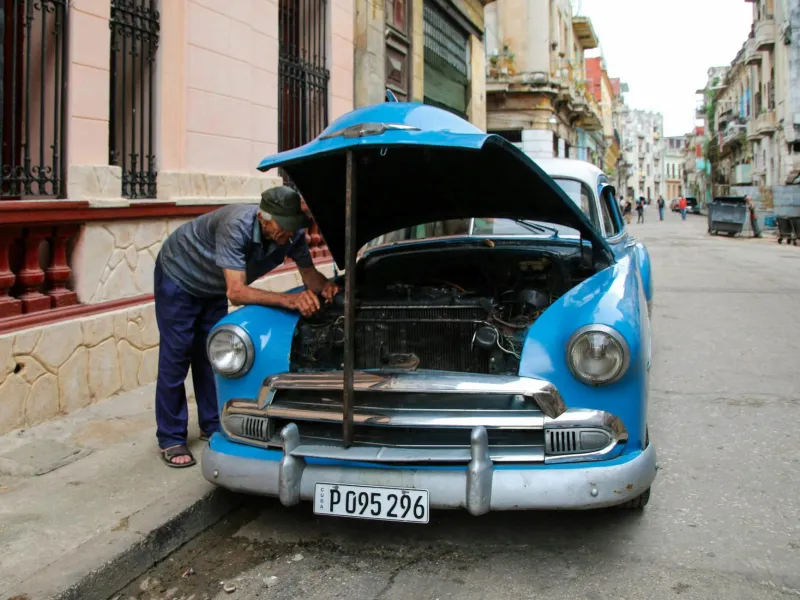
"People named their cars back then, and they meant it," says automotive historian Mike Mueller. "You'd drive the same car for ten or fifteen years, getting it repaired whenever something went wrong. You knew every sound it made, every quirk in how it handled. That's a completely different relationship than trading up every three years."
This intimacy with objects extended to understanding how they worked. Most Americans could perform basic repairs on their own possessions because products were designed to be user-serviceable. Radios had removable backs and clearly labeled tubes. Appliances came with repair manuals written for homeowners, not just technicians.
Children grew up watching their parents maintain and repair household items, learning that taking care of things was a normal part of adult responsibility. The idea of throwing away something that could be fixed seemed wasteful in a way that went beyond mere economics—it violated a cultural value about stewardship and responsibility.
The Great Shift to Disposable
The transformation didn't happen overnight. Through the 1960s and 1970s, manufacturing gradually shifted toward designs that prioritized low initial cost over longevity. Shoes began using glued construction that couldn't be resoled. Electronics moved to integrated circuits that made individual component replacement impossible. Appliances adopted sealed systems that required specialized tools to service.
"Planned obsolescence wasn't a conspiracy—it was a response to consumer demand for cheaper products," explains economist James Hamilton. "When you could buy a new radio for less than it cost to repair the old one, the repair shops started disappearing. It became economically irrational to fix things."
Global manufacturing accelerated this trend. Products made overseas were often cheaper to replace than repair, especially when replacement parts had to be shipped internationally. Local repair shops couldn't compete with the economics of mass production and global supply chains.
By the 1990s, the transformation was complete. The neighborhood cobbler became as rare as the neighborhood blacksmith. Electronics repair shops evolved into cell phone stores that sold accessories and service contracts rather than actual repairs. Even luxury items began following throwaway patterns—a broken Rolex might get repaired, but a broken Timex went in the trash.
What We Lost in Translation
The disappearance of repair culture had consequences beyond just economic ones. When we stopped expecting things to last, we stopped valuing durability in our purchasing decisions. When we stopped understanding how things worked, we became more dependent on experts for even simple problems. When we stopped maintaining our possessions, we lost the satisfaction that comes from caring for something over time.
"There's a psychological difference between owning something you can fix and owning something you'll eventually throw away," notes behavioral economist Dan Ariely. "When you know you can repair something, you take better care of it. When you know it's disposable, you treat it as disposable from day one."
The environmental costs became apparent decades later, as landfills filled with products that previous generations would have repaired multiple times. The economic costs showed up in household budgets that allocated increasing percentages to replacing rather than maintaining possessions.
The Repair Renaissance
Interestingly, repair culture is showing signs of revival among younger Americans who never experienced it the first time around. YouTube has become the apprenticeship system for a new generation of DIY repairers. "Right to repair" movements are pushing manufacturers to make products more serviceable. Urban areas are seeing the return of specialized repair shops, often with long waiting lists.
"My customers are mostly people in their twenties and thirties who are tired of throwing things away," says Maria Santos, who opened a shoe repair shop in Portland, Oregon, in 2019. "They bring in expensive boots or designer shoes and they're amazed that I can make them look new again. For them, it's like discovering a superpower they didn't know existed."
 Photo: Portland, Oregon, via portlandrentalmanagement.com
But this revival faces the same economic headwinds that killed the original repair economy. Products are still designed for disposal, replacement parts are still hard to find, and repair skills are still rare. What was once a neighborhood service has become a boutique luxury.
The cobbler's hammer and the radio repairman's soldering iron represented more than just tools—they represented a worldview where things were meant to last, where skilled hands could restore what seemed broken, and where the relationship between people and their possessions was built on stewardship rather than consumption. In losing that world, we gained convenience and lower prices, but we may have traded away something more valuable: the deep satisfaction of making things last.