When Flying First Class Actually Felt Like Luxury — The Vanishing World of Elegant Air Travel
The Golden Age Nobody Remembers
Step into a time machine and land at a major American airport in 1965. You'd notice something immediately jarring: almost nobody is there. Commercial aviation wasn't a mass market yet. Flying across the country was an event significant enough to warrant getting dressed up for—and the price tag reflected that exclusivity.
A round-trip ticket from New York to Los Angeles cost roughly $600 in 1965 dollars. Adjusted for inflation, that's about $5,800 in 2025 money. Only roughly 6 percent of Americans had ever set foot on a commercial aircraft. For most people, flying wasn't a transportation option. It was a luxury good, like owning a boat or a second home.
But if you were among the privileged few who could afford it, the experience was genuinely opulent in ways that modern air travel has completely abandoned.
What You Actually Got for Your Money
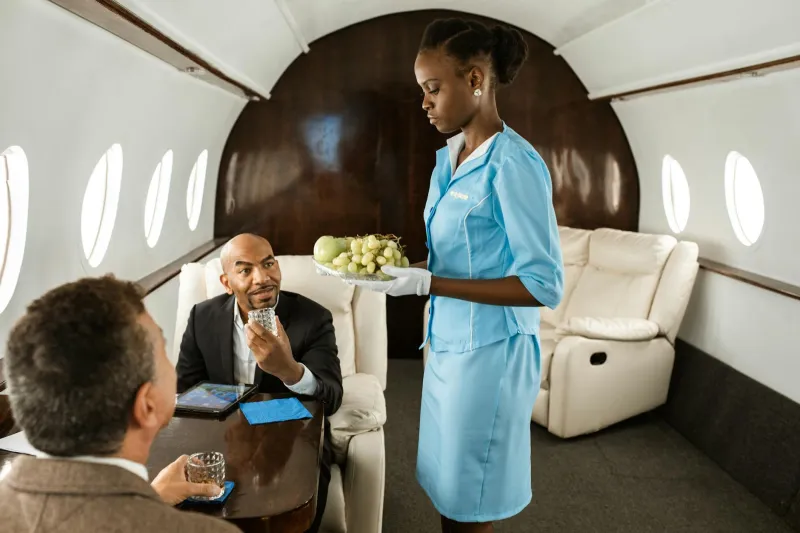
Walk down the cabin of a 1965 Boeing 707 and you're struck by the space. Seats were wider. Legroom was genuinely comfortable. The cabin was quieter—jet engines were loud, but the aircraft themselves felt less cramped. Flight attendants—exclusively women, dressed in tailored uniforms that looked like they belonged in a high-end hotel—moved through the aisles with an unhurried grace that seems almost incomprehensible now.
Meal service wasn't an afterthought or a revenue opportunity. It was central to the flying experience. On a cross-country flight, you received multiple courses: appetizers, a substantial entree prepared in the galley, vegetables, salad, bread, and dessert. The silverware was actual metal. The plates were ceramic. Drinks—alcoholic or otherwise—were complimentary and unlimited. Flight attendants circulated constantly, checking on passenger comfort.
There was no baggage fee. No seat selection fee. No carry-on restrictions. No middle seat trap. Smoking was permitted in the rear of the cabin, but the overall atmosphere remained refined. Passengers dressed formally. Men wore suits and ties. Women wore dresses or skirts. There was an understood dignity to the experience.
A first-class ticket in 1965 wasn't just a seat. It was an entire worldview about what air travel should represent: an escape from the ordinary, a taste of wealth and status, an experience worth remembering.
The Great Democratization—And What It Cost
Fast forward to today. A first-class ticket from New York to Los Angeles might cost $1,200 to $2,000 in actual dollars—cheaper in real terms than 1965, but the experience has fundamentally changed.
Modern first class is spacious, certainly. The seats recline into beds on international flights. The technology is impressive: seatback screens with hundreds of entertainment options, USB charging, Wi-Fi. But the meal service, while still present, has been industrialized. It arrives on a tray, pre-assembled somewhere in a corporate kitchen, and reheated in a galley oven. The silverware is plastic. The experience feels efficient rather than luxurious.
Meanwhile, the democratization of air travel created an entirely new economy class experience—one that would have been unthinkable in 1965. Today's standard domestic flight charges for baggage. Seat selection costs extra. Boarding is stratified into multiple tiers. The middle seat is genuinely cramped. Meal service on a three-hour flight might be a small bag of pretzels and a drink. The cabin feels packed because it is: modern aircraft are configured to maximize revenue per flight, not passenger comfort.
Spirit Airlines and Frontier Airlines represent the logical endpoint of this transformation: rock-bottom fares paired with fees for everything—carry-ons, checked bags, seat selection, even printing your boarding pass at the airport. A $99 ticket becomes $300 by the time you've paid for the basics.
The Uncomfortable Question
So here's what modern aviation has genuinely accomplished: it made flying affordable for the middle class. A family earning $75,000 a year can now take a vacation to Florida. That's genuinely democratic. That's real progress.
But we've also created a system where the experience itself has been stripped down to its functional minimum. Flying isn't an occasion anymore. It's a commodity. The airline industry optimized for volume and margin, not satisfaction. The result is that more people fly, but fewer people enjoy it.
In 1965, flying was rare enough that it remained special. Today, 2.9 million Americans fly every single day. Airports are crowded. Planes are full. The experience is stressful, transactional, and designed primarily to extract revenue at every possible touchpoint.
You could argue this is the inevitable price of progress. You could also argue that somewhere in the rush to make flying affordable, we forgot to ask whether we actually wanted to make it pleasant. The answer to that question reveals something deeper about how American capitalism evolved over the past sixty years: we chose volume over quality, access over experience, and price over dignity.
The real question isn't whether modern air travel is better or worse than 1965. It's whether we actually got a better deal—or just a different one.