Lost Without a Signal: The Forgotten Art of Getting Somewhere Before GPS
Lost Without a Signal: The Forgotten Art of Getting Somewhere Before GPS
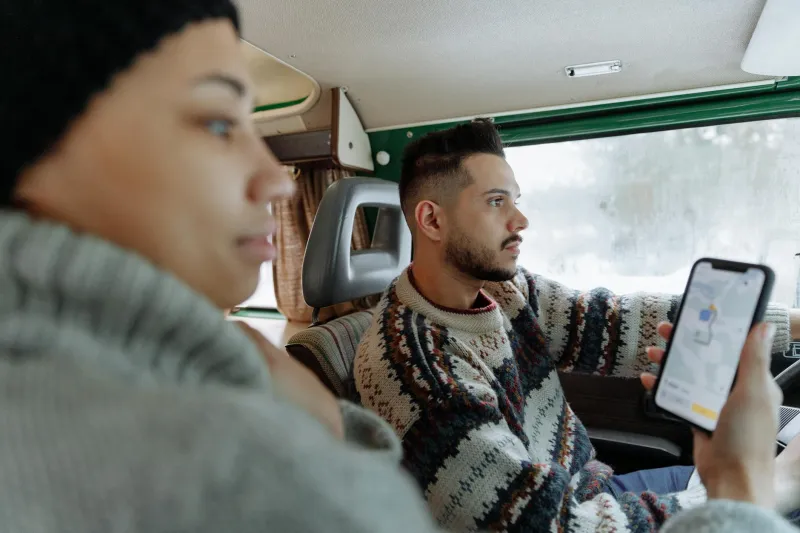
Somewhere in America right now, someone is standing in a parking lot, phone raised toward the sky, waiting for their map app to recalculate. They're mildly annoyed. They've been rerouted. They might be two minutes late.
In 1987, that same situation — unfamiliar city, wrong turn, no idea where you are — could derail an entire day.
Navigation used to be a skill. A real one. And the story of how Americans went from unfolding a paper map on the hood of a car to barking "navigate home" at a phone is one of the most quietly dramatic transformations of modern life.
The Glove Compartment Was a Library
Before smartphones, before MapQuest, before even the earliest consumer GPS devices, the glove compartment of a well-prepared American car held a small but essential archive: road maps. Not one — several. One for your home state, one for wherever you were heading, maybe a national atlas if you were ambitious.
These weren't decorative. They were infrastructure. Rand McNally and AAA produced millions of them every year, and American families treated them like essential travel gear alongside the spare tire and the emergency flashlight. Unfolding one in the passenger seat while your driver squinted at exit signs was a legitimate co-pilot role.
The catch? Road maps were static. They couldn't tell you about the construction zone that appeared last Tuesday, the bridge that was closed for repairs, or the fact that the road you were counting on had been renamed. They reflected the world as it was when they were printed — which, on a long trip through unfamiliar territory, could be a problem.
The AAA TripTik: America's Original Turn-by-Turn
For longer journeys, the serious traveler turned to AAA. And AAA, for much of the twentieth century, offered something called a TripTik: a custom-prepared, spiral-bound booklet of maps that walked you through your route, page by page, from start to finish.
You'd visit a AAA office — in person — days or even weeks before your trip. A staff member would sit down with you, plan your route, and assemble a personalized booklet with highlighted roads, suggested stops, and notes about potential hazards or construction. It was thorough, thoughtful, and completely analog.
The TripTik was genuinely impressive for its time. But it also required advance planning that today's traveler would find almost unimaginable. You had to know where you were going before you left. Spontaneity had a cost.
Gas Stations Were Navigation Hubs
If you got lost — and you would get lost — the gas station was your first call for help. Not because they sold maps (though they did), but because the attendant behind the counter usually knew the area. In small towns and rural stretches, the person pumping your gas or working the register was often a local who could give you directions from memory.
"Turn left at the old Miller farm, go about three miles until you see the water tower, then hang a right at the intersection" was a completely normal set of directions in pre-GPS America. Landmarks mattered. Compass directions mattered. Mile markers mattered. You had to hold all of it in your head and trust your gut when the road didn't look quite right.
Some people were genuinely good at this. Others were chronically, legendarily bad at it. Before navigation apps, your ability to find your way around said something real about you.
The Emotional Weight of Being Lost
Here's something worth sitting with: being lost used to feel different. Before the era of instant recalculation, a wrong turn in an unfamiliar city wasn't a minor inconvenience — it was a genuine problem. You didn't know how far off course you were. You didn't have a satellite overhead drawing you a new path in real time. You had to figure it out yourself.
Family road trips had a specific kind of tension around navigation. The driver who refused to stop and ask for directions became a cultural cliché for a reason — because getting lost was a real enough experience to generate real enough frustration. Arguments happened. Hours were lost. Destinations were sometimes missed entirely.
There was also, for some people, a particular satisfaction in finding your way. Reading a map correctly, anticipating the right exit, arriving somewhere you'd never been without a single wrong turn — that felt like something. It was a small competence, but it was yours.
What We Gained — and What Quietly Disappeared
The arrival of consumer GPS devices in the late 1990s and early 2000s changed things gradually, then all at once. Early units were clunky and expensive, mounted on dashboards like afterthoughts. Then smartphones arrived and dissolved the entire category into an app most people never think about.
Today, the average American has access to navigation technology that would have looked like science fiction in 1985. Real-time traffic data. Satellite imagery. Alternate routes calculated in seconds. Turn-by-turn audio instructions that adjust on the fly. It is, by any objective measure, a staggering improvement.
But something slipped away quietly in the transition. Spatial awareness — the ability to hold a mental map of a place, to understand where you are relative to where you've been — is a skill that atrophies when you stop using it. Studies have suggested that heavy reliance on GPS navigation may actually reduce our ability to build internal maps of our environment.
The paper map in the glove compartment, the TripTik assembled at the AAA office, the gas station attendant drawing a route on a napkin — they required you to engage with geography in a way that a blue dot on a screen simply doesn't.
Finding Your Way Forward
We are unambiguously better at getting places than we used to be. Faster, more reliably, with far less stress. The transformation is real and the benefits are obvious.
But it's worth pausing, just once, to appreciate what the pre-GPS world demanded of ordinary travelers: attention, preparation, memory, and the humility to pull over and ask. Those weren't small things. They were how a generation of Americans learned to navigate not just roads, but uncertainty.
Now we just tell the phone where we want to go. And it takes us there. Every time.
Progress is funny like that.