Posters, Pins, and Mix Tapes — When You Had to Work to Know What You Loved
The Wall That Took Years to Build
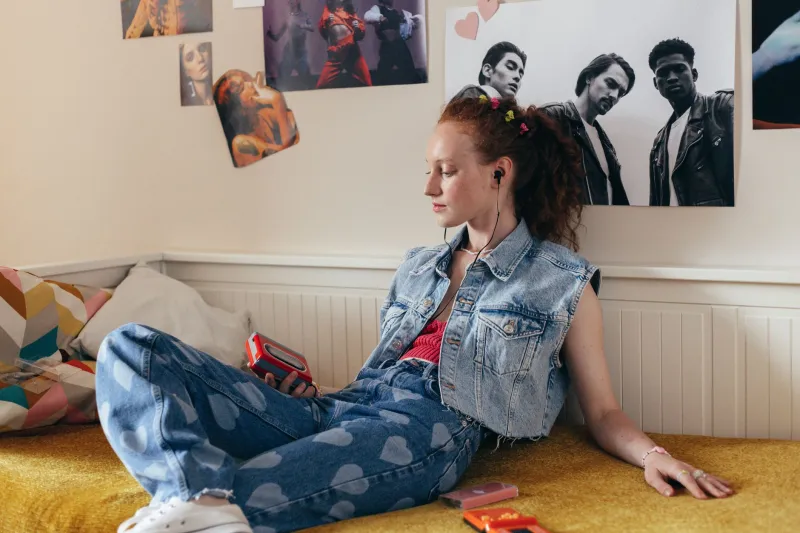
If you grew up in the 1980s or 1990s, your bedroom wall was basically a thesis statement. Every poster had a story. That Nirvana print came from a record store two towns over that you saved up three weeks of lawn-mowing money to visit. The magazine clipping of a movie still was cut out carefully with scissors because you'd watched that film four times and it meant something you couldn't quite articulate yet. The handwritten lyrics in the corner were copied out from the liner notes of an album you played until the tape wore thin.
Nothing on that wall arrived by accident. Every piece of it was chosen — hunted down, traded for, or carefully preserved. And in the act of choosing, you were figuring out who you were.
That process was slow, sometimes frustrating, occasionally expensive, and completely irreplaceable. Because it was yours.
Discovery Used to Cost Something
Finding new music in 1991 required effort. You listened to the radio and stayed ready to hit record. You borrowed albums from friends and copied them onto cassette. You read the liner notes obsessively and followed band members' other projects across years. You went to shows in small venues and discovered three bands you'd never heard of because they were opening for someone you drove two hours to see.
Every recommendation came from a human being who cared enough to make it. Your older brother putting a record in your hands and saying "trust me" was a meaningful act. The girl at school who made you a mix tape was sharing a piece of her interior world. The music store clerk who leaned over the counter and said "if you like that, you need to hear this" — that was a relationship, not an algorithm.
The same was true for movies, books, and fashion. You found things through proximity, conversation, accident, and persistence. You stumbled into a genre you didn't know existed because the video store was out of what you actually came for. You read an author you'd never heard of because someone left their paperback on the bus.
Serendipity required friction. And friction produced identity.
When the Feed Learned to Predict You
Somewhere around the mid-2000s, recommendation engines started getting genuinely good. Pandora launched in 2005. Spotify arrived in the US in 2011. YouTube's autoplay algorithm became increasingly sophisticated. Netflix began refining its suggestion system until it could predict with remarkable accuracy what you'd want to watch next.
The experience of discovering something you love didn't disappear — but it changed profoundly. Instead of hunting, you were being served. Instead of stumbling, you were being guided. The friction was gone, and with it went something harder to name.
Algorithms are trained on your behavior. They learn what you've clicked, how long you listened, when you skipped, what you returned to. They get very good at finding more of the same — slightly different versions of what already worked. They optimize for engagement, which in practice means they tend to confirm your existing tastes rather than challenge them.
The old system, messy as it was, pushed you toward things you didn't know you wanted. The new system is extraordinarily good at giving you more of what you already know you like.
The Identity Question Nobody's Asking
Here's the part that gets genuinely strange: if an algorithm can predict your preferences before you've consciously formed them, what does that mean for the idea of personal taste?
Teenagers in 1988 built their identities through a process of active exploration and deliberate choice. The music you loved, the movies you quoted, the clothes you wore — all of it required decision-making. You had to decide you were a person who liked that thing. The choice was part of the identity.
Today, a sixteen-year-old's Spotify Wrapped tells them who they are at the end of the year. Their TikTok For You page reflects a version of them that the platform assembled from their behavior. Their aesthetic — the colors, the references, the vibes — arrives pre-packaged from a corner of the internet that identified their type and started feeding them content accordingly.
None of this is entirely bad. Exposure to more music, more artists, more global culture is genuinely valuable. A teenager in rural Nebraska in 1993 had almost no access to underground hip-hop or international cinema. Today, that same teenager can find virtually anything within minutes. The breadth of available culture is staggering.
But breadth and depth are different things. And the shortcut to discovery might be costing something in the development of genuine, hard-won taste.
What the Bedroom Wall Understood
The bedroom wall was a record of effort. It documented the work you'd done to figure out who you were. Every item on it represented a decision, a commitment, a moment of recognition. When you looked at it, you saw your own history of becoming.
Today's equivalent — a curated Instagram aesthetic, a Spotify playlist, a Pinterest board — can be assembled in an afternoon. It can look just as personal. It can even feel personal. But the process that produced it is fundamentally different: curation by algorithm rather than discovery by effort.
The gap between those two processes is bigger than it looks. One builds identity from the outside in. The other used to build it, slowly and imperfectly, from the inside out.
Maybe both have value. But it's worth noticing what changed — and what we stopped asking teenagers to do for themselves.