Pop the hood of a 1985 Chevrolet, and you'd see an engine. Pop the hood of a 2025 model, and you're looking at what amounts to a computer that happens to move a car around.
This transformation — from mechanical to digital, from fixable to replaceable — represents one of the most dramatic shifts in American consumer life. Cars became vastly more reliable, but they also became something most people can no longer understand, let alone repair.
When Saturday Meant Getting Your Hands Dirty
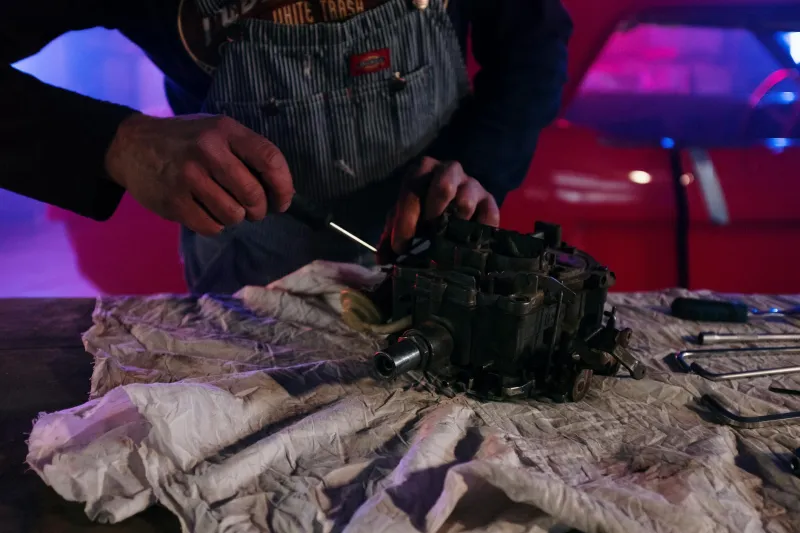
In 1980, weekend warriors across America could be found in driveways and garages, elbows deep in engine bays. Changing your own oil wasn't just economical — it was expected. Replacing brake pads, adjusting carburetors, swapping out alternators, even rebuilding engines were all within reach of anyone willing to buy a Chilton's manual and spend a Saturday learning.
"I taught all my kids to change their own oil and check their belts," says Mike Rodriguez, 67, a retired machinist from Detroit. "My grandson drives a 2022 Honda. I can't even find the oil dipstick."
The typical repair bill in 1985 might run $50-150 for most common problems. Not because parts were cheaper — though they often were — but because labor was measured in hours, not days. A competent backyard mechanic could handle 80% of what went wrong with the average car.
The Diagnostic Revolution That Changed Everything
The shift began in the 1990s as emissions regulations demanded more precise engine control. Carburetors gave way to fuel injection. Mechanical systems became electronic. Warning lights multiplied from a few basic indicators to dozens of specific alerts.
By 2000, the Check Engine light had become the most feared symbol in American transportation. Unlike the mechanical problems of earlier eras — which usually announced themselves with obvious symptoms like grinding, squealing, or smoking — modern car problems often hide behind cryptic error codes that require specialized scanners to interpret.
"We used to be able to listen to an engine and know what was wrong," explains Tom Martinez, who's been running an independent repair shop in Phoenix for thirty-five years. "Now the car has to tell us what's wrong, and sometimes it's lying."
When $3,000 Became the New $300
Today's average car repair bill tells the story of this transformation. What used to be a $200 fix can easily become a $2,000 ordeal. Replace a modern transmission control module? That's $1,500 before labor. Need a new hybrid battery? Start saving for $4,000. Even relatively simple repairs like replacing sensors can run $500-800 because accessing them requires dismantling half the engine bay.
The tools required for modern car repair represent another barrier. A basic OBD-II scanner — essential for diagnosing any modern vehicle — costs what a full set of wrenches used to cost. Professional-grade diagnostic equipment can run $10,000-50,000, putting it far beyond what any weekend mechanic could justify.
The Reliability Trade-off
Here's the paradox: while cars became harder to fix, they also became far less likely to need fixing. A 1980 vehicle might need major repairs every 60,000-80,000 miles. Today's cars routinely run 150,000-200,000 miles with just basic maintenance.
Modern engines are engineering marvels. They run cleaner, more efficiently, and longer than anything from the carburetor era. Fuel injection systems optimize performance thousands of times per second. Computer-controlled transmissions shift more smoothly than any human driver could manage.
The trade-off was mechanical simplicity for electronic sophistication. Americans gained reliability but lost the ability to understand what they were driving.
The Death of Shade Tree Mechanics
The cultural impact extends beyond individual repair bills. For generations, mechanical aptitude was a common form of American self-reliance. Fathers taught sons (and increasingly daughters) to change oil, gap spark plugs, and adjust timing. Auto shop classes were standard in high schools.
That knowledge transfer largely stopped in the 1990s. Why teach someone to adjust a carburetor when carburetors were disappearing? Why learn to time an engine when computers handle timing automatically?
"My dad could rebuild an engine in our garage," says Jennifer Walsh, 34, from Denver. "I can't even change my own air filter without voiding the warranty."
The New Repair Economy
Modern car repair has become a high-tech, high-skill profession requiring constant education and expensive equipment. Independent mechanics compete with dealership service departments that have direct access to manufacturer diagnostic tools and software updates.
For consumers, this means fewer choices and higher costs. The corner garage that could fix anything is being replaced by specialized shops that focus on specific makes or systems. Even oil changes — once the ultimate DIY job — have become complicated by different oil specifications, electronic monitoring systems, and hard-to-access drain plugs.
What We Lost Along the Way
The mechanical era wasn't perfect. Cars broke down more often, got worse gas mileage, and polluted more. But they also fostered a different relationship between Americans and their vehicles — one based on understanding rather than dependency.
When you could fix your own car, you understood how it worked. When something went wrong, you had options: fix it yourself, take it to any mechanic in town, or even limp it home and deal with it later. That flexibility has largely disappeared.
Today's drivers are more like passengers in their own vehicles — dependent on systems they can't understand, diagnose, or repair. The car has become a black box that either works or doesn't, with little middle ground.
The Road Ahead
As vehicles become even more computerized — with electric powertrains, autonomous systems, and over-the-air updates — the gap between driver and machine will only widen. Future cars might be more like smartphones on wheels: incredibly capable, remarkably reliable, and completely opaque to their users.
The weekend warrior with a socket set is becoming as obsolete as the blacksmith. In gaining cars that rarely break, we lost the satisfaction of fixing them when they did.