She Knew Your Inseam, Your Budget, and Your Mother's Name — Before Retail Forgot You Existed
There was a woman at the Macy's in downtown Cincinnati — or the Marshall Field's in Chicago, or the Nordstrom in Seattle, depending on which American city you grew up in — who had been working the women's clothing floor for twenty-three years. She knew regular customers by name. She remembered that you'd bought a navy blazer two springs ago and that it hadn't quite worked with your shoulders. She would look at you, briefly and without drama, and pull three things off the rack that would actually fit.
You didn't ask her to do this. She just did it. It was her job, and she was extraordinarily good at it.
That woman, and the entire retail ecosystem she represented, is largely gone. What replaced her is more complicated than it first appears.
The Department Store as Social Architecture
To understand what was lost, you have to understand what the mid-century American department store actually was. It wasn't just a place to buy clothes. It was a civic institution — a climate-controlled public space that served as backdrop for a particular kind of urban social life.
The fitting room experience was genuinely different. You'd bring in four items with the help of a knowledgeable salesperson, try them on, and receive honest feedback from someone who had no interest in flattering you into a bad purchase. Returns were possible but not the default. The expectation was that you'd leave with something that worked, because the whole point of the exercise was to find something that worked.
Salespeople on those floors were specialists in a real sense. They knew fabric behavior — how a certain weave would hold its shape through a season, how a particular cut would age. They understood the difference between what a customer said they wanted and what they actually needed. They were, in modern parlance, consultants. They just weren't paid like it.
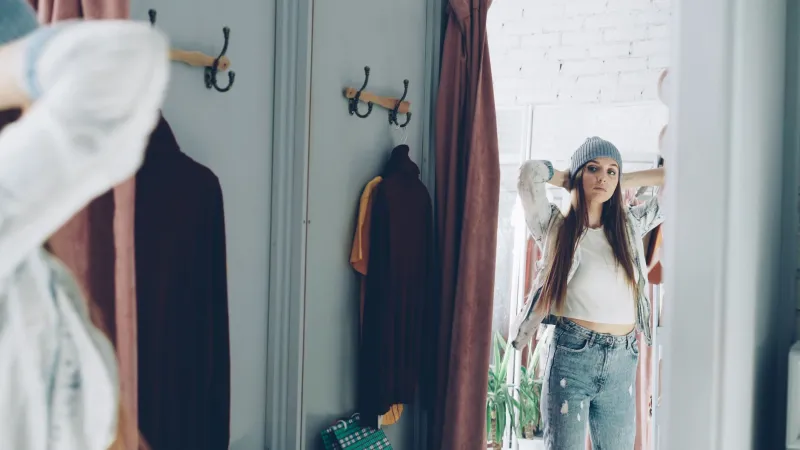
The fitting room itself was a semi-social space. You'd emerge from the curtain and get opinions — from the salesperson, sometimes from other customers nearby, occasionally from whoever you'd brought along. Clothes shopping was a communal act with a shared goal: find something that fits this specific human body.
The Real Estate of Retail
Here's something worth noting through a real estate lens: the decline of the department store is inseparable from the transformation of American commercial property. The anchor tenant model — where a Sears or a JCPenney anchored a mall and drew foot traffic to smaller retailers around it — was one of the defining commercial real estate structures of the twentieth century.
At its peak in the 1990s, there were roughly 1,500 enclosed malls operating across the United States. By 2023, that number had fallen to under 700 functioning properties, with analysts estimating that as many as half of remaining malls could close or be repurposed within the next decade. Dead malls have become a legitimate real estate asset class — properties being converted to distribution centers, medical facilities, mixed-use housing, and community spaces.
The square footage that used to house fitting rooms, shoe departments, and lingerie sections is now, in many American cities, either vacant or being reimagined entirely. The physical infrastructure of the personal shopping experience is being demolished or repurposed at a pace that makes the cultural shift feel very concrete.
The Algorithm Doesn't Know Your Shoulders
Online retail arrived with a genuine value proposition: more options, lower prices, the ability to shop at midnight in your pajamas. These are real advantages, and they clearly resonated — American e-commerce sales have grown from essentially zero in the mid-1990s to over $1.1 trillion annually as of 2023.
But the replacement for the knowledgeable salesperson has been, to put it charitably, imperfect. Size charts vary so dramatically between brands that the same woman might wear a 6, an 8, and a 10 across three different retailers. AI recommendation engines are getting better, but they're working from purchase history and browsing data, not from the reality of how your body actually occupies space in a garment.
The result is the great American return culture. Roughly 17% of all US retail purchases — and as much as 30% of online clothing purchases — are returned. The environmental cost of this is significant: returned goods generate millions of tons of waste annually, with a substantial portion ending up in landfills because the economics of restocking them don't work. The convenience of free returns created an entirely new category of environmental damage.
And paradoxically, despite having access to more clothing options than any previous generation in human history, Americans consistently rank getting dressed among their top daily stressors. The paradox of choice — the psychological phenomenon where more options produce less satisfaction — turns out to apply very directly to standing in front of a closet full of things that don't quite fit.
What the Gap Looks Like
The distance between then and now in retail isn't really about clothing. It's about expertise and relationship and the particular kind of efficiency that comes from being known.
The woman on the Macy's floor who remembered your size and your mother's name was providing something that no algorithm has fully replicated: a human judgment applied to a human body, informed by years of accumulated knowledge and genuine attention. That service existed because the economics of retail once supported it. Those economics changed, and the service went with them.
What we have instead is infinite scroll, free shipping both ways, and a closet full of almost-right. The options expanded. The expertise evaporated. And somewhere in that trade, getting dressed went from something people were helped with to something people do alone, in front of a screen, hoping the measurements match.