The Frames You Wore for Twenty Years — When Eyeglasses Were Built to Last and Nobody Expected Otherwise
There's a good chance you remember someone in your family who wore the same pair of glasses for an almost unreasonable amount of time. A grandfather with the same wire-rimmed frames for fifteen years. A mom whose oversized 80s frames outlasted two hairstyles and a kitchen renovation. Nobody thought it was odd. Glasses were a medical device. You wore them until they broke or your prescription changed enough to matter.
That relationship with eyewear — practical, boring, durable — is almost unrecognizable today.
When Glasses Were Just Glasses
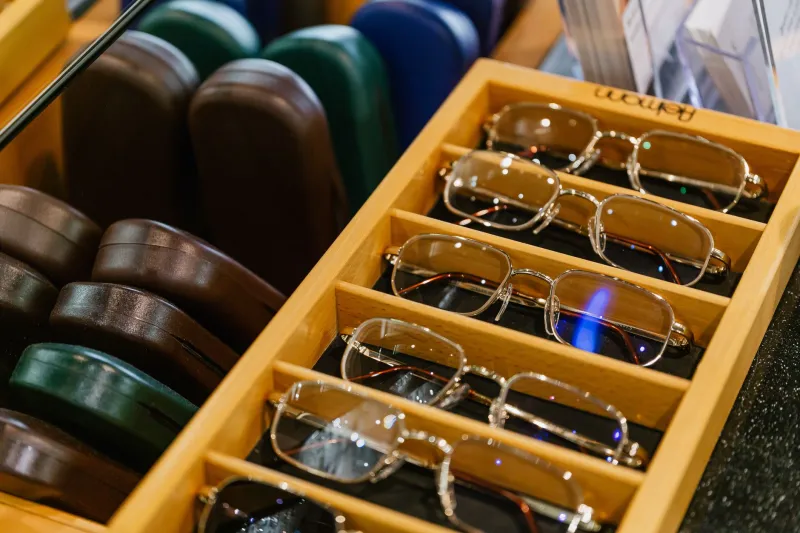
For most of the 20th century, eyeglasses occupied the same mental category as hearing aids or orthopedic shoes: functional equipment you got from a professional and maintained until it stopped working. The selection at most optometrists was limited by design. A small tray of frames, maybe two dozen options, organized by size. You picked the ones that fit your face and didn't cost too much. The end.
Frames were built from materials meant to last — metal alloys, acetate, sometimes early plastics that could take genuine abuse. Lenses were ground thick and heavy because optical clarity was the only metric that mattered. Style was an afterthought, if it was a thought at all.
A pair of glasses in the 1970s or 80s might cost $50 to $100 out of pocket — roughly $150 to $350 in today's dollars. That was a significant purchase, which is exactly why people treated it like one. You took care of them. You had them adjusted. You replaced a screw before you replaced the frame.
How Fashion Moved In
The transformation didn't happen overnight, but it accelerated sharply through the 1990s and 2000s as luxury brands discovered eyewear.
Designer labels — Versace, Prada, Ray-Ban, Oakley — began marketing frames as fashion accessories rather than medical equipment. Licensing deals flooded the market with branded eyewear at premium prices. The optometrist's office started to feel more like a boutique. Display cases expanded. Seasonal styles appeared. The idea that you might want a second pair — one for everyday, one for going out — was introduced with the subtlety of a billboard.
By the 2010s, the average retail price for a complete pair of prescription eyeglasses in the US had climbed to between $200 and $600, with designer frames regularly running $400 to $800 before lenses. A single pair from a brand-name optical retailer, with anti-reflective coating, blue light filtering, and progressive lenses, can now easily top $1,000.
The frames themselves often cost more than the precision optics inside them — a reversal of every priority that once governed how glasses were made and sold.
The Fast-Fashion Disruption
The luxury end of eyewear got complicated when direct-to-consumer brands showed up and started selling prescription glasses for $95. Companies like Warby Parker — launched in 2010 — built an entire business model around making eyewear affordable, stylish, and easy to replace. The implicit message was clear: these are glasses you can swap out seasonally, like a jacket.
On one hand, this democratized access to eyewear in genuinely useful ways. On the other, it quietly shifted the cultural expectation. If glasses are cheap enough to replace every year, then maybe you should replace them every year. The durability that once made a pair of frames a ten-year investment became, in the new framing, a kind of style failure.
Today, the average American replaces their glasses every two to three years — not because the frames broke, and not always because the prescription changed significantly, but because the frames feel dated. That's a marketing victory disguised as consumer preference.
The Prescription Treadmill
There's a legitimate reason prescriptions change over time — eyes do evolve, particularly through your 40s and beyond. But the frequency with which Americans are now updating their eyewear often outpaces genuine optical need.
Vision insurance plans, widely used in the US, typically offer a new frame allowance every one to two years. That benefit structure, while helpful, also creates a use-it-or-lose-it incentive to replace glasses on a schedule rather than based on actual need. Optometrists — often operating inside retail optical chains that profit from frame sales — have a financial interest in encouraging upgrades.
The result is a system that moves glasses off shelves far faster than any change in visual acuity would require.
What You're Actually Spending Now
The aggregate math is striking. A person who wore one pair of glasses for ten years in 1985 might have spent $200 total on eyewear in that decade. A person who updates their prescription glasses every two years today, buying a mid-range pair at $350 each time, spends $1,750 over the same ten-year window — and that's before accounting for a backup pair, sunglasses, or the reading glasses that become necessary in middle age.
For a family of four where multiple members need corrective lenses, the ten-year eyewear bill can exceed $8,000. That's not a rounding error in the household budget. That's a used car.
The Gap Between Then and Now
The old pair of glasses sitting in your grandmother's medicine cabinet — scratched, slightly bent, prescription long outdated — represents something more than a style artifact. It represents an era when a medical device was built to be kept, not cycled through.
Eyeglasses didn't become disposable because people stopped needing durable ones. They became disposable because the industry figured out that disposable was more profitable — and then convinced everyone that wanting something that lasts was somehow behind the times.
The frames haven't changed that much. The expectation around them has changed entirely.