The Mental Map That Made You Fearless — And the App That Quietly Replaced It
At some point in the mid-2000s, a generation of Americans quietly stopped knowing where they were.
Not lost, exactly. Just uncalibrated. Dependent. Following the blue dot without any particular understanding of the territory around it. Turn left in 400 feet. Turn left in 400 feet. Continue for two miles. You arrive at your destination.
And you have almost no idea how you got there.
This wasn't always the deal. For most of American life, knowing where you were — and how to get somewhere else — was a basic life skill, the kind of thing you developed gradually through years of moving through your city, your region, your country. It lived in your head. And losing it wasn't really possible, because it was part of you.
The Geography You Built Yourself
Growing up in almost any American city or suburb before the smartphone era meant spending years constructing a mental map of your surroundings. It started small — your block, your neighborhood, the route to school. Then it expanded. The way to a friend's house in the next neighborhood. The shortcut through the industrial park. The back road that avoided the traffic light on Route 9.
This wasn't taught in any formal sense. It accumulated through experience — through taking wrong turns and figuring out where you ended up, through reading street signs and cross-referencing them with what you already knew, through asking someone at a gas station and then translating their directions ("go past the old Kmart, turn left at the light where the Dairy Queen used to be") into actual navigation.
All of that was, in its own way, a form of learning. Spatial cognition — the brain's ability to understand and remember geography — is a real and measurable skill. And like most skills, it developed through use.
Researchers at University College London famously studied London cab drivers, who were required to memorize the entire city's street layout to earn their license. The studies found that the hippocampus — the brain region associated with spatial memory and navigation — was measurably larger in experienced cabbies than in the general population. Navigation, done repeatedly and from memory, was literally reshaping their brains.
Nobody's hippocampus is growing from following a GPS route.
The Paper Map as a Relationship With Place
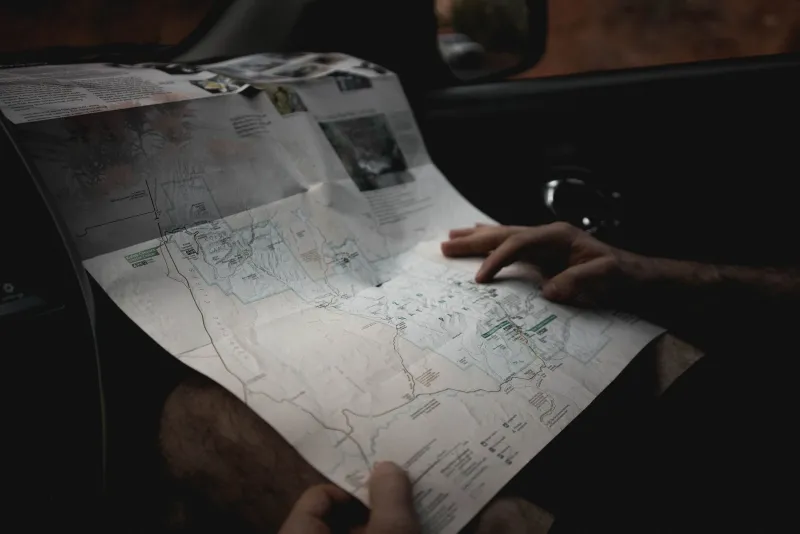
Before GPS, the road trip had a different texture. Before leaving home, you sat down with a map — the folded paper kind, the kind that never quite folded back the right way — and you studied the route. You identified the major highways, the cities you'd pass through, the rough distance between legs of the trip. You built a mental model of the journey before it started.
Then, on the road, you read the landscape. Exit numbers, mile markers, the shape of the skyline on the horizon. You knew roughly where you were in relation to where you'd been and where you were going. You were a participant in the geography, not a passenger being guided through it.
And when you got lost — which happened — you had to solve the problem. You pulled over. You looked at the map. You figured out where you'd gone wrong and how to correct it. Or you stopped at a gas station and asked. And the person behind the counter told you something like, "You're about six miles east of where you want to be — take this road north, you'll hit 40 in about four miles." And you filed that information away, and it became part of what you knew about that part of the country.
Getting lost was a minor inconvenience that almost always turned into knowledge.
What the Blue Dot Took Away
GPS navigation is, in the most straightforward sense, a remarkable technology. It's accurate, fast, constantly updated, and available to virtually every American with a smartphone. It has prevented countless wrong turns, reduced driving stress, and made it genuinely easier to get around in unfamiliar places.
But there's a cost that doesn't show up in the product reviews.
Studies published in journals including Nature Communications have found that people who rely heavily on GPS show reduced activity in the hippocampus during navigation, compared to those who navigate from memory. The brain, it seems, doesn't engage with geography the same way when it's being directed. It outsources the task and steps back.
The result is a population that is, in measurable ways, less spatially aware than previous generations. People who have used GPS since they started driving often can't describe the geography of their own city in any meaningful way. They know the route from point A to point B — but only as a sequence of turns, not as a spatial reality.
Ask someone who grew up navigating without GPS to describe the layout of their city, and they'll draw you a rough map — neighborhoods, major roads, rough distances, cardinal directions. Ask someone who's navigated exclusively by phone, and they'll often struggle to say which direction downtown is from where they're standing.
Directions as Human Connection
There's a social dimension to this worth mentioning. Asking for directions was, for most of American history, a normal form of human interaction. You stopped someone on the street, or pulled into a parking lot, or walked into a business, and you asked a person how to get somewhere.
That exchange was brief, but it was real. It was a transaction between two people in the same physical place, one of whom knew something the other needed. It required a certain willingness to admit you were lost, and a certain trust that the stranger would help you. And they almost always did.
That kind of low-stakes, functional human contact has been almost entirely eliminated. It's been replaced by something more efficient and considerably less human.
Finding Your Way Back
The argument here isn't that GPS is bad. It isn't. The argument is that the skill it replaced was worth something, and we let it go without much of a goodbye.
There are small ways to push back. Drive somewhere unfamiliar without turning on navigation — just look it up beforehand and try to hold the route in your head. Walk a new neighborhood without your phone open, just to see what you notice. Buy a paper map of your state and actually read it.
These feel like slightly eccentric choices in 2025. But they're also the kinds of choices that keep a skill alive — the skill of knowing where you are, in the most literal sense.
The world is still out there, full of geography. You just have to look up from the blue dot long enough to see it.