The Index Card That Knew Everything: When Home Cooking Was Knowledge You Actually Owned
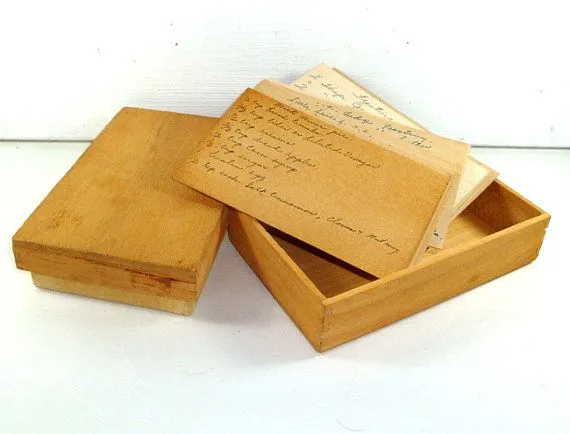
Photo: vintage handwritten recipe cards wooden box kitchen nostalgia, via i.pinimg.com
Somewhere in a kitchen drawer — maybe your grandmother's, maybe your mom's — there's probably a box. It might be wooden, or tin, or just a rubber-banded stack of index cards so worn the corners have gone soft. The handwriting on them belongs to someone who's been gone for years. The measurements are approximate. Some cards are stained with evidence of the dish itself.
That little box held something more valuable than it looked: knowledge that belonged completely to your family. Knowledge nobody could take away, cancel your subscription to, or serve you an ad alongside.
American home cooking didn't always need the internet to function. For most of the 20th century, it ran on something far more durable — accumulated skill, shared tradition, and the quiet confidence of people who knew how to feed their families without looking anything up.
The Kitchen as Classroom
For most of American history, cooking was learned the way all practical knowledge was learned: by being in the room while someone else did it. Children stood at their mother's elbow and watched. They were handed tasks before they fully understood the recipe. They were told things like "cook it until it smells right" or "you'll know when the dough feels ready" — instructions that sound vague until you've done it enough times that they make perfect sense.
By the time a young woman — and yes, it was almost always women — set up her own household, she didn't need a recipe for pot roast or biscuits or Sunday gravy. She already knew. The recipe card box she kept wasn't a reference manual for daily cooking. It was more like a library of special occasions, family favorites, and things she'd clipped from the newspaper and wanted to try.
The economics of this were quietly significant. A family that could cook from scratch, improvise with what was on hand, and stretch a pound of ground beef into three different meals across a week was a family that spent dramatically less on food. Cooking wasn't just a domestic skill — it was a financial strategy.
When Cooking Became Content
The transformation didn't happen overnight. It started with the proliferation of convenience foods in the 1950s and '60s — boxed mixes, canned soups repurposed as sauces, frozen dinners that promised to liberate women from the stove. Then came the celebrity chef era of the '80s and '90s, which turned cooking into something to watch as much as something to do.
But the real rupture came with the internet. Suddenly, there were millions of recipes available for anything you could imagine. That sounds like abundance, and in some ways it was. But something strange happened alongside it: people stopped memorizing how to cook and started searching for it instead.
When you can look up any recipe in thirty seconds, the motivation to actually learn — to internalize the technique, to understand why the butter needs to be cold or why you rest the meat — quietly fades. Why carry knowledge in your head when your phone holds all of it?
The result is a generation of home cooks who can make almost anything once, by following a video step by step, but who struggle to cook confidently without a screen in front of them. The knowledge is available, but it isn't owned. It's rented from an algorithm.
The Subscription Kitchen
Then came the meal kit industry, which arrived around 2012 and grew into a multi-billion-dollar business by the end of that decade. Companies like HelloFresh and Blue Apron offered pre-portioned ingredients and laminated instruction cards — essentially, cooking with training wheels, delivered to your door at a significant premium.
The average meal kit costs somewhere between $9 and $12 per serving. A home cook working from a recipe and buying their own groceries can often produce the same meal for $3 to $5 per serving. The meal kit isn't just selling convenience. It's selling the confidence that got quietly eroded when cooking stopped being something Americans grew up doing.
And then there's the content layer on top of all of it: Instagram cooking accounts, TikTok recipe videos, food influencers with millions of followers, YouTube channels devoted to single dishes. Cooking has become one of the most consumed categories of content on the internet — watched far more than it's practiced.
There's a particular irony in that. We're more exposed to cooking than any previous generation in history, and simultaneously less equipped to walk into a kitchen and feed ourselves without external guidance.
What Got Lost in the Translation
The recipe card box wasn't just a collection of instructions. It was a record of a family's relationship with food — what they liked, what they made when someone was sick, what showed up on Christmas morning and nowhere else. The stains and the margin notes and the handwriting were part of it. The knowledge was personal in a way that a Google search result simply isn't.
When cooking was passed down through demonstration and practice, it came bundled with other things: time spent together in the kitchen, conversation that happened over chopping and stirring, a sense of competence that carried over into other areas of life. You weren't just learning to make chicken soup. You were learning that you were someone who could make chicken soup — and that distinction matters more than it sounds.
Financially, the shift has been real and measurable. Americans now spend more on food away from home than on groceries — a reversal of a pattern that held for most of the 20th century. The average American household spends roughly $3,500 a year eating out, on top of grocery bills that have risen sharply in recent years.
None of that is entirely about cooking skills. But some of it is. A family that can cook confidently from a mostly-stocked pantry, improvise with leftovers, and pull off a weeknight dinner without consulting an app is a family with a quiet financial advantage that rarely shows up in any budget spreadsheet.
The Card Is Still There
The good news — if there is any — is that the knowledge isn't gone. It's just sitting in a box somewhere, waiting. The gap between the cooking that lived in those index cards and the cooking that lives on our phones isn't unbridgeable. It just requires treating the kitchen like a classroom again, and accepting that some things are worth knowing by heart.